mercredi 3 novembre 2021

To some extent I don't want us to solve the climate crisis

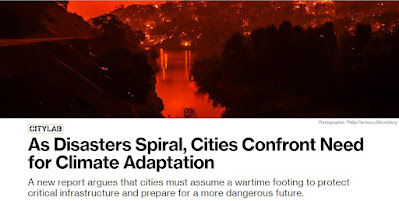
The climate crisis is the tip of the iceberg. As a symptom of a disease finding solutions to the climate crisis with habitual criteria of cosmetics is not addressing the bigger issues: everything else must change too in order to achieve a permanent result.

On the surface, it is mostly the result of the Industrial revolution of the late XVIIIth century on. We have to go deeper though. It is the result of a mindset of exploitation and greed that has been going on for ages. So if resolving the climate issue ends up making sure we avoid thinking in a different manner how to behave on this planet we won't have learned a thing and it won't last long. Either the climate will still be problematic or the depletion of what's left of resources will make it even harder to survive.

For time immemorial we have been placed here to create a paradise and though over time attempts have been made to achieve this goal, those attempts usually did not last long either because envy and jealousy set in or the guidance given by those who created those spaces were not followed through which made them crumble.

There is no common goal which should be to live in harmony with nature. After all this is not by thinking of colonizing other planets that we will grow in wisdom, let alone make those potential planets more of the same that we have made this one become: a dump

Hierarchy should be based on spiritual values not on grand standing in a field, would that be in business or sciences or anything else. If those we call our leaders are among the worst behaved individuals everything else will follow that path. It is useless to come to terms with climate change if we don't change. Materialism and consumerism have either chocked or killed the idea of spirituality and the sacred. We are mere machines serving the goals of capitalism. 

I would not have taken such a stand before, for fear of being an easy target of laughters. Now it doesn't matter anymore because humans have lost all credibility and are on the verge of annihilating themselves and everything and everyone who did not ask for this or were certainly not consulted. I thus have nothing to lose in thinking differently.

Everything was given to us. Every piece of wisdom that we have to know to work out a paradise is known and yet we do mostly the contrary of the guidances painstakingly brought to us via phophets, wisemen and women. All we want is proof that we are not just an assembly of atoms by chance and though proof is what we find at every level of living things and a universe, it is not enough. Jesus was put to sleep with nails on a cross because he was threatening the power in place. 2000 years later we ain't smarter in any way. Oh yes, we discovered stuff but it is only applied if there is a buck to be made about it. That is our nowaday wisdom. At best this is mediocre and participate in our destruction.

Yesterday in Glascow we learned that 90 countries accept to end deforestation by the years 2030! Well, this is such an achievement... At the pace we're cutting the forest in acceleration it is going to be a race to finish the job and by then there might not be any forest left anyway. This "agreement" should have been an international convention at least five decades ago. This is how we advance the cause.

I am not about to announce the end of the world. I don't need to. The material world is only a tiny fraction of the whole spectrum of dimensions or planes on which we exist. But if we do not make this material world a better place we will not graduate to better planes. There is no issue. Our misfortune and hardship are of our own making. The rule of money is a construct.of our own making. This is not the way of the cosmos. Retribution exists on all planes but you won't find cash or credit card elsewhere.

Suzanne Simard on the secret societies of trees
The Current with Matt Galloway
November 2, 2021
Listen
Transcript

Everything, All the Time, Everywhere
How We Became Postmodern
by Stuart Jeffries
A radical new history of a dangerous idea
Postmodernism stood for everything modernism rejected: fun, exuberance, irresponsibility. But beneath its glitzy surface, postmodernism had a dirty secret: it was the fig leaf for a rapacious new kind of capitalism. It was the forcing ground of “post truth,” by means of which western values were turned upside down. But where do these ideas come from and how have they impacted on the world?
In this brilliant history of a dangerous idea, Stuart Jeffries tells a narrative that starts in the early 1970s and still dominates our lives today. He tells this history through a riotous gallery that includes, among others: David Bowie, the iPod, Madonna, Jeff Koons’s the Nixon Shock, Judith Butler, Las Vegas, Margaret Thatcher, Grand Master Flash, I Love Dick, the RAND Corporation, the Sex Pistols, Princess Diana, Grand Theft Auto, Jean Baudrillard, Netflix, and 9/11.
We are today scarcely capable of conceiving politics as a communal activity because we have become habituated to being consumers rather than citizens. Politicians treat us as consumers to whom they must deliver. Can we do anything other than suffer from buyer’s remorse?

Libellés : , , , , ,

dimanche 25 juillet 2021

We need to talk of mutation instead of transition

How are you? I'm fine. For a good thirty years I could say that I have been fundamentally serene. On the other hand, I am inconsolable about the planet and what we do to it. Not only does it seem that most people have not changed their lifestyle one iota both on the North American continent and among those who imitate it all over the place, but that should be put in place immediately. essential measures to be able to face the climatic disasters to come. In all areas we are very late and we will act in a violent and anarchic manner when the effects of the climate hit us hard.

Click to read the article

That being said, I also direct my gaze towards positive aspects since it cannot be claimed enough that all positive gestures, even symbolic ones, are so many balms on the numerous wounds posed by the civilization of materialism. It takes a humanistic or spiritual base (the two exist side by side) to take actions that aim to remedy, alter or obliterate the unfortunate actions that humans take. Pretty much there won't be enough of these positive gestures to prevent disaster as the scale between them is at least 1:10.

So what is the desirable mutation? It is personal before being collective because it must be integrated into individual gestures before wishing a community of spirit which will be expressed immediately if a number of individuals endorse it and act. collectively. Only catastrophic circumstances (or a dictatorship) force an orchestration, a more or less solid coordination to obtain a semblance of consensus and it is not sure that this will hold up over time.

In the 60s and 70s and even 80s, a certain youth became aware of the absurdity of the system in which they were born and tried to conceive of alternatives. This more or less worked for all kinds of reasons, including that of not being able to reach consensus on a particular type of operation and the fact that all these experiences were not properly networked, which would have allowed everyone to be able to integrate units in which they would have felt better.

During this period many books and guides were published in North America and Europe.

Click to consult the catalog
Whole Earth Catalog, 1969

Click to consult the book
Survival into the 21th century, 1979


What differentiates the then model from that of the present is that the then model was an autonomous realization, outside the State and institutions. We did not speak of disasters then and today it is more the States and institutions that will try to produce the necessary needs in the event of disasters. UBC has a school dedicated to risk management and apprehended disasters.

Click to consult the site
On the other hand, the 'authorities' could quickly find themselves overwhelmed by the scale of the needs, the breakdown of communications and roads, etc. Should we not then design programs that would allow individuals to organize themselves, without waiting for states and institutions to do so, such as this program offered by the University of North Carolina.

Click to consult the site


Libellés : , , ,

dimanche 3 mai 2020

Four arguments for the elimination of privately owned cars...

The article title is in part borrowed from a book title: "Four Arguments for the Elimination of Television, by Jerry Mander which was published 40 years ago.
I will be attempting here to make my arguments for the elimination of cars. Of course this will be short. A book would have to be written to expose thoroughly each argument. This is the basis to any change of paradigm: the elimination of private car ownership. Everything else is a tributary of this. So if we do not operate this elimination of private owned cars, nothing else goes.
First argument: owning a car is a religion. We have to change religion.
We have to go back to a time when there were no cars! This is an argument dealing with the use of time and a looming climate crisis. Cars have made possible an ever-ending urban sprawling. Anyone can argue about the 'convenience' of cars ad nauseam but the fact is cars have made our life an incredible burden on our relationship to our existence on the biosphere, disintegrating the necessity to deal with our surroundings. We have to do a 180° and reinvent our civilization to a time without cars and with the modern tools at our disposal: better collective way of transportation, internet. We have to surpass the worst aspect of thie industrial revolution and plan a future that allows for a natural pace. This will help eliminating most of our deseases, linked to our lifestyle.
Second argument: cars are weapons of mass destruction
Cars have existed for a century now. Each year worldwide there are 1.2 million people being killed by cars. That's more than all the people who died during all the wars on the planet since the beginning of time. And this is only the people being killed by cars. Collateral damages run in the tens of millions depending on the years: people being injured, having nervous breakdowns, being killed by the enormous amount of pollution cars create, not mentioning all the animals being swept away by cars every minute. Each car produces its own weigh in pollutants every year.
Third argement: Cars make us forget about our natural belonging
The multiplication of cars makes for a miserable life for most people who spent half their wages nourishing their cars. We organize our cities for the cars. Half of the space in any given city is for cars thus expanding further and further the realm of a city. The reality that has been created for us and that we willingly embrace for its apparent convenience is a smokescreen nonetheless. We are unable to perceive the distraction it is from assuming our main role as a species, that is a role of stewardship over the planet.
Fourth argument: The time we spend in cars is time not spent on anything else
Hence we are being fooled in thinking that cars are convenient for transportation. If we were to built our cities differently with work, leisure, supplies at walking distance we would not need cars. We would meet people in the streets, spend more times with our love ones, read a book (here the argument is the same that could be brought up concerning television), we would find time to be more creative, etc.
Here is a quotation from Jerry Mander book mentioned at the top . It applies as much to television as it applies to cars or any construct we cart around with us:
Psychiatrist R. D. Laing, among others, has said that the growing incidence of mental illness these days may be explained in part by the fact that the world we call real and which we ask people to live within and understand is itself open to question. The environment we live in is no longer connected to the mix of planetary processes which brought us all into being. It is solely the product of human mental processes. It is real, but only in the way that a theatrical play or a fun house is real. Our artificial environment is there and we can experience it, yet it has been created on purpose by other humans. It is an interpretation of reality; it no longer reveals how nature works and it cannot provide much useful information to human beings who seek to see their own lives as part of some wider natural process. We are left with no frame of reference untouched by human interpretation.

Listen to  "Something in the air", from The Nature of Things on CBC TV
Air pollution is a major killer, even in places we think of as 'safe,' so scientists are using new technology to measure it and study its effects on our bodies.
§ § §

Libellés : , , , , , , ,